Wrong. This type of 'bottom-up' or grassroots thinking forces change. In small amounts, there is little impact. But if enough people set their printers to "duplex" then everybody above the consumer will be impacted. There are plenty of examples of this happening, and it seems to work well. Industry is forced to adapt, change, or quit. If this were the way all things happened, we might not even have large monopolies like we do now. My initial cynical view of this was that if we all use less paper, half of the people in the industry will lose their jobs. It's not a perfect way to solve problems, but it sure does keep those with power (and/or money) on their toes.
Saturday, December 6, 2008
Bottoms up!
I was planning on giving this post the title "conservation vs. the economy" but as I kept thinking about it, it doesn't have to be that way. As Al Gore pointed out in An Inconvenient Truth, there should be no set of scales with Earth on one side and gold bars on the other, ever trying to find some balance between the two. But I started thinking: Say a company reduces it's paper consumption by half. The paper supplier will lose that much business, and that much less of a tree will be made into paper. Not much impact here, but if you apply this concept to the entire economy, there may be some problems. If every company which currently uses paper reduces their consumption by half, then each part of the paper supply chain will lose half of its business. So we should keep using paper, right?

Which "economic baddie" do you prefer? Vote now!
Here's an idea: A list of options will be given to community leaders, cities, states and other organizations, and each must select which economic baddie, or NIMBY type project, they prefer. Areas with these unwanted projects are excluded from the initial list until everyone has an equal share. Each will be forced to decide how they wish to take responsibility for our great economy in reward for all the great things we have. Here are some of the options to choose from:
- prison
- nuclear power plant
- low-income housing
- homeless transitional center
- nuclear waste site
Each of these will have to be weighted - some are more applicable for a state, while others for a neighborhood or small community. If this is a true democracy (which it isn't) then we should have the right to choose if we have the right to deny. Or better yet, we should appreciate the right to choose how we wish to take responsibility for all the things we benefit from. Because people never want to take responsibility, it would have to be forced. If everyone must choose something, it may make it easier to justify since no one will be treated unfairly.
Which would you choose?
Saturday, November 29, 2008
Natural Capitalism - "nature optimizes"
Natural Capitalism is my favorite book to date. The clipping below is taken from Chapter 6, "Tunneling Through the Cost Barrier", which entertains the fact that better education and learning from nature can make us more efficient and productive:
"Many architects, engineers, and other designers, however, are not being well taught. J. Baldwin, long the technology editor of Whole Earth Review, was told on his first day in design school that 'design is the art of compromise.' Design, he was instructed, means choosing the least unsatisfactory trade-offs between many desirable but incompatible goals. He believed that this formulation described 'a political technique masquerading as a design process,' and he realized this was wrong... For the past 3.8 billion years or so, nature has been running a successful design laboratory in which everything is continually improved and rigorously tested. The result, life, is what works. Whatever doesn't work gets recalled by the Manufacturer. Every naturalist knows from observation that nature does not compromise; nature optimizes. A pelican, nearing perfection (for now) after some 90 million years of development, is not a compromise between a seagull and a crow. It is the best possible pelican."
Hawken, Paul and Amory Lovins and L. Hunter Lovins. Natural Capitalism: Creating the Next Industrial Revolution. New York: Hachette Book Group USA, 1999.
Friday, November 28, 2008
OpenOffice, oh how I love thee...
This doesn't relate to the environment, but it has something to do with sustainability. Since Microsoft released the ever-incompatible Office 2007 products (Word, Excel, etc) I have cussed any computer that uses it. The 2007 products use a new file type which cannot be opened by previous versions of Office. This is utterly absurd! I use OpenOffice.Org, a "free and open office suite" (openoffice.org), and I too was having problems opening the files created with the new 2007 products. But alas, my problem has been solved!
OpenOffice.Org has released it's 3rd version which will open Microsoft Office 2007 files!!!! I am speechless - this is simply amazing. I was almost ready to install Microsoft Office Excel to allow me to do work compatible with everyone else, but now I can open, edit and save any 2007 files with Open Office! This calls for a parade!
Friday, November 14, 2008
Recycling - to sort or not to sort?
I recently saw a video that changed my perspective on recycling. In a previous article, I promoted the possibility of a project that strived to create a recycling bin that sorted lots of different types of items in a somewhat efficient way. After watching a video about a city recycling program where they sort at the factory rather than on the truck, I realized this must be much more efficient.
I don't have hard evidence, but think about it. Sorting out all these recyclables takes time, energy and space to achieve. Trash is all loaded into one bin, able to collect millions of different things. Recycle bins, on the other hand, are all single-use. One for bottles and cans, one for computer paper, one for newspaper, one for paperboard, one for corrugated cardboard, etc etc. This is bonkers!
The original reason why I promoted the 'all-encompassing' recycle bin was because I hated finding a plastic bottle bin when i wanted to recycle my newspaper. Most recycle bins are scattered around my campus, and each location doesn't have every type of recyclable. Some do, but most dont.
SO, why not put everything together? Imagine putting your city recycle bin out on the street, all mixed together, and rather than the truck coming by, stopping, sorting everything next to the truck, then driving 50 feet down the road and getting the neighbor's bin, why not just grab it and go like the trash truck? The trash truck has a giant arm that grabs the trash can, dumps it in the back, and drives on - much faster than the recycle man. There's no telling how much fuel, time, and personnel this would save. The personnel could instead work in the factory where the sorting takes place. Trucks dump the recyclables on a conveyor, and workers sort the recyclables into the right collection bin.
I will try to find the video I watched to share what I'm referring to. Hopefully you, too, will see how much sense this makes! In the meantime, try these articles that are for and against sorting at the factory:
Tuesday, October 7, 2008
Comparing Vehicle MPG Ratings and Lifetime Costs
In today's economy of high gas prices and diminishing credit, consumers are feeling their wallets get lighter by the minute. Some people have found short-term remedies to the situation, and others can't see the light at the end of the tunnel. If you have already exhausted the tips and tricks to better fuel economy in your SUV, you may already be considering buying a more fuel efficient vehicle. I whipped up some charts that may be helpful in determining how high you can fly with MPG ratings, and how to get the most MPG for your buck! Before getting too far into this, I want to quickly explain the concept of lifetime costs. Lifecycle costs = production costs + operation costs. Still with me? Read an educational example about it here. The classic example compares standard incandescent light bulbs to newer Compact Fluorescent bulbs. The conclusion is that, although the compact fluorescents are more expensive, they last much longer, meaning that it would take several inexpensive incandescent bulbs to replace it. Therefore you "save" money of the "life" of the light bulb.
Now, let's get into the lifecycle costs of two vehicles: Vehicle A, which as a lower initial price (the incandescent bulb) but a higher operational cost, and Vehicle B, which has a higher initial price (the compact fluorescent) but a lower operational cost.
First, some nifty charts.
 These charts attempt to put in perspective the differences in fuel costs that you could expect from vehicles at 20, 30, 40, 50, and 60 MPG ratings. As you can see, the differences between each increasing level of MPG gets smaller as the MPG gets higher. In the per-mile chart, the difference in jumping from a 20 MPG vehicle to a 3o MPG vehicle is $.06 per mile, or $903 annually (rated at 15,000 miles per year - see fueleconomy.gov). So, given the above information, it's time to make some assumptions.
These charts attempt to put in perspective the differences in fuel costs that you could expect from vehicles at 20, 30, 40, 50, and 60 MPG ratings. As you can see, the differences between each increasing level of MPG gets smaller as the MPG gets higher. In the per-mile chart, the difference in jumping from a 20 MPG vehicle to a 3o MPG vehicle is $.06 per mile, or $903 annually (rated at 15,000 miles per year - see fueleconomy.gov). So, given the above information, it's time to make some assumptions.You drive a 20 MPG vehicle. You are deciding which car you should buy to cut down on fuel costs to drive your car. So, you find two cars online that seem nice: (A) a cool new Chevy, rated at 30MPG for $15,000, or (B) a more humble Toyota, rated at 40 MPG for $22,000. Which do you think will "save" you money over the life of the vehicle? Comparing this example to the light bulb example is not exactly fair since cars do not typically just stop working at the end of their life, so we may have to assume that, "After 5 years, I will sell the car and buy a new one." That way we have a definite lifespan to allow for easier comparison. Here's what we've got so far:
Vehicle A: Chevy
30 MPG
$15,000 pricetag
Vehicle B: Toyota
40 MPG
$22,000 pricetag
Assumptions: You drive exactly 15,000 miles per year. Fuel prices never change and costs $3.61 per gallon. The life of the vehicles is 5 years, at which point the car will be sold and replaced with a new, possibly more efficient car. Depreciation, time value of money, resale value and maintenance costs are not factored. You can afford the initial purchase price of either vehicle, and the vehicle will be paid 100% in cash at the time of purchase.
Yes, I know, these are a lot of assumptions, and we want to be environmentally friendly - but this has to be a legitimate test, right? Don't worry, our conclusions will consider the tree-hugging factor. :) Also, remember that some of these assumptions may effect both cars similarly, so they are not significant.
Now, onward! some simple calculations of differences between vehicles A and B:
The initial price difference: $7,000
Annual Fuel cost difference: $451.00 per year
So, our hypothesis is that the operational savings (from the higher MPG) will result in MORE than a $7,000 savings over the 5 years of owning the car. If our hypothesis is correct, it will be worthwhile to pay the additional $7,000 today for Vehicle B to get better gas mileage. To test our hypothesis, we will multiply the difference in annual fuel cost by 5 years:
$451.00 x 5 years = $2,255.00
Well, our hypothesis was incorrect. It is not financially worthwhile to buy Vehicle B solely on the basis of getting better gas mileage for 5 years.
Oh no! .... let's not stop there...
$451.00 x 10 years = $4,510.00
Welp, it's not even worth it for 10 years!
=======
The purpose for this experiment was to provide a little assistance in understanding the hysteria and making the best decision for you. I am very interested in protecting the environment just as much as saving money, but it is important to make smart choices based on these concerns. If protecting the environment is worth it to you, then go for the higher MPG car. You'll feel better about yourself and the environment, even though it cost you a little more. But I think it's important to see that just because a vehicle gets the best gas mileage on the road doesn't mean it will save you money.
I hope that you can use this experiment in your own considerations like this. It's been proven that Compact Fluorescents will save you money over the long-run. I am NOT telling you that all fuel efficient cars are bad, or they cost this much more, etc. Just know how to assess the situation and consider all that's involved. It may just be that cars which are 10 MPG more fuel efficient only cost $2,000 more in price, and would therefore be worthwhile to purchase.
$451.00 x 20 years = $9,020.oo
You can keep your car for 20 years, and you'll "save" over $2,000! Yippee!
Sunday, September 14, 2008
commuting by bike
I've been commuting to and from home and campus in Columbia, SC for the past few years, and thought I should share my experiences and encourage people to give it a try.
Buy a helmet, and wear it.
Starting out, I would suggest riding on sidewalks to get yourself comfortable with riding around cars. Be very cautious at intersections and driveways where cars may be crossing the sidewalk and may not see you. Check out a map (Google Maps has "walking directions" that are pretty neat) and see what looks like a good route (see my route). In choosing a route, consider the amount of car traffic present, the width of the road (extra wide right lanes and lots of paralell parking are good) and how flat it is. Also try to avoid major intersections which can be difficult to get through without using a crosswalk. My route is 2.1 miles according to Google Maps, and it generally takes me between 15-20 minutes. If I drive my truck it takes me about 12 minutes to get to the parking lot, and another 5-10 to walk to class. At 20mpg, that's about $0.80 rountrip; $2.80 per workweek, $140 per work year (discounted for average rain days) - not to mention saving the planet ;)
So what do you take with you?
I often wear gym shorts while riding and pack regular shorts/pants in my Camelbak 3L Rim Runner. It holds 3 Liters of water and has enough room for a pair of pants, a textbook, two notebooks, calculator, pens, mp3 player, etc. Sunglasses are a must. If you like to ride with music, make sure to set the volume so you can still hear what's going on around you. I also reccomend over-the-ear headphones instead of the in-ear/earbud type. I carry a lightweight allen wrench multi-tool, a Topeak portable tire pump, plastic tire spoons, and a spare inner tube with me at all times - just in case. I know it sounds like a lot, but it will keep you from
Don't have a road bike?
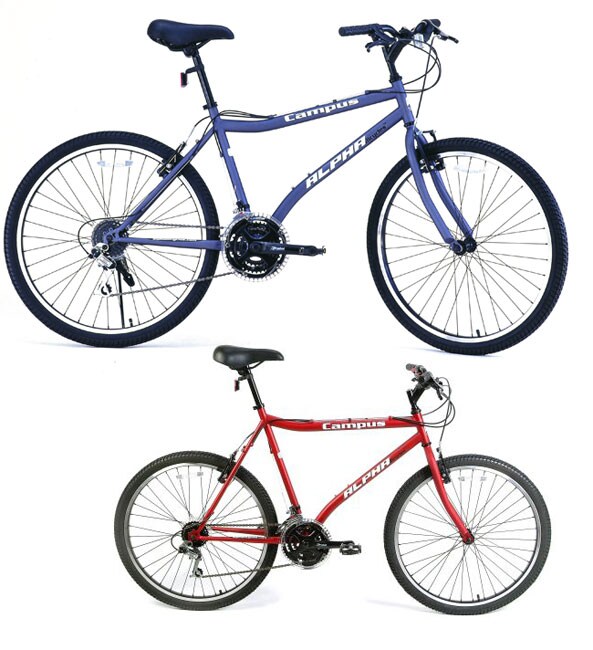
Me neither. I have an old steel-frame Diamondback Outlook mountain bike similar to this with no suspension. Bikes like this are cheaper and easy to find used. If you're serious, head to your local bike shop and pick up a pair of slick tires and 3 matching inner tubes (gotta have a spare) for about $40-50 to get a better ride.
Do it in the road
Once you get used to making the trip, try riding in the road. I average between 10-15mph, so keeping up with downtown traffic isn't too difficult. I believe it's safer than riding on the sidewalk because drivers turning at an intersection are less likely to see a fast-moving bike crossing the street at a crosswalk. If you prefer the sidewalk, you may want to get off your bike and walk across intersecting streets or slow down and keep a sharp eye out for turning vehicles.
This is my route, taking Sumter street.
It's flat, has wide traffic lanes and is a straight shot. Sumter has traffic lights at every block, but they change often, keep traffic slow and provide shorts breaks along the way. I cross three main roads: Main, Elmood and Gervais streets. I used to go this way, but I didn't like the intersection at Bull and Elmwood, it was slower, and there were lots of turns. Sumter is a straight shot and has slow traffic.
Once you establish a good route, share it!
Post a comment here with a link, and feel free to describe your commute.
Friday, April 25, 2008
Welcome
Welcome to the website! I would like to post topics about how you can actually save money and the environment. I am slowly building a system to create and manage a consulting business to help businesses, residents and the like to save money by using energy more efficiently.
Modern Recycling
I've always been perturbed by recycling bins scattered around an area, such as a college campus, where they are more difficult to find than trash cans (and if you do find one, it probably doesn't accept the recyclable you happen to be holding). This prototype trash can/ recycle bin is right alongside my idea of what we should have. Everywhere there is a trash can, there should be (greater than or equal to) the same amount of space for recycling. The prototype above is a great start, but I don't think it allocates the correct amount of space for each section. To really impact the way we dispose of unwanted things, the waste bin should be smaller and more discrete, yet still useful enough to avoid trash being put in the wrong sections.
So the next time you are ready to dispose of something recyclable, RECYCLE IT!
So the next time you are ready to dispose of something recyclable, RECYCLE IT!
public transportation
I recently finished a paper on alternative transportation for my Green Politics class. Our city's current policy for designing and implementing dedicated 'bike lanes' in the city is very young. Bike lanes are totally dependent on roads getting resurfaced (repaved), and even then they are only considered to be installed. My solution was to create an ordinance that would use the current research to 'install' new bike lanes on roads that were wider than necessary. This would follow the same principles as the 'repave first' plan because the main cost is simply the extra paint. The alternative requires 'blacking out' all the lanes on the road, repainting lines, etc. which can be very expensive.
Subscribe to:
Posts (Atom)